Industrial Painting in Lawrenceville: Coatings Built to Outlast Rust and Humidity
Beautifying residential and commercial establishments since 1984
Signs Your Facility's Coatings Are Failing
Rust bleed, chalking, and peeling near seams are the first signs a coating is breaking down. Catching them early can mean a maintenance coat instead of a full strip and recoat. Gwinnett County’s humidity swings speed up failure on steel and concrete.
Walk the building’s exterior once a season. Rust streaks running from bolt heads or seams are usually the first thing we spot. Chalking comes next — the powdery residue that rubs off on your hand, meaning UV exposure has broken down the coating’s resin. It shows up first on south-facing warehouse walls off Sugarloaf Parkway that take sun most of the day.
- Blistering or bubbling paint, often a sign moisture is trapped under the coating
- Peeling at seams, corners, or around fasteners
- Fading or color change on one side of a building but not another
- Chipping near loading dock doors and high-traffic touchpoints
- Visible rust bleeding through the topcoat
The difference between cosmetic and structural matters here. Surface chalking is cosmetic. Rust bleeding through metal means the substrate is already corroding, and waiting means paying for metal repair before painting. Failure usually starts small, at a seam or a low spot where water pools, then spreads.
Commercial vs. Industrial Painting: Picking the Right Scope
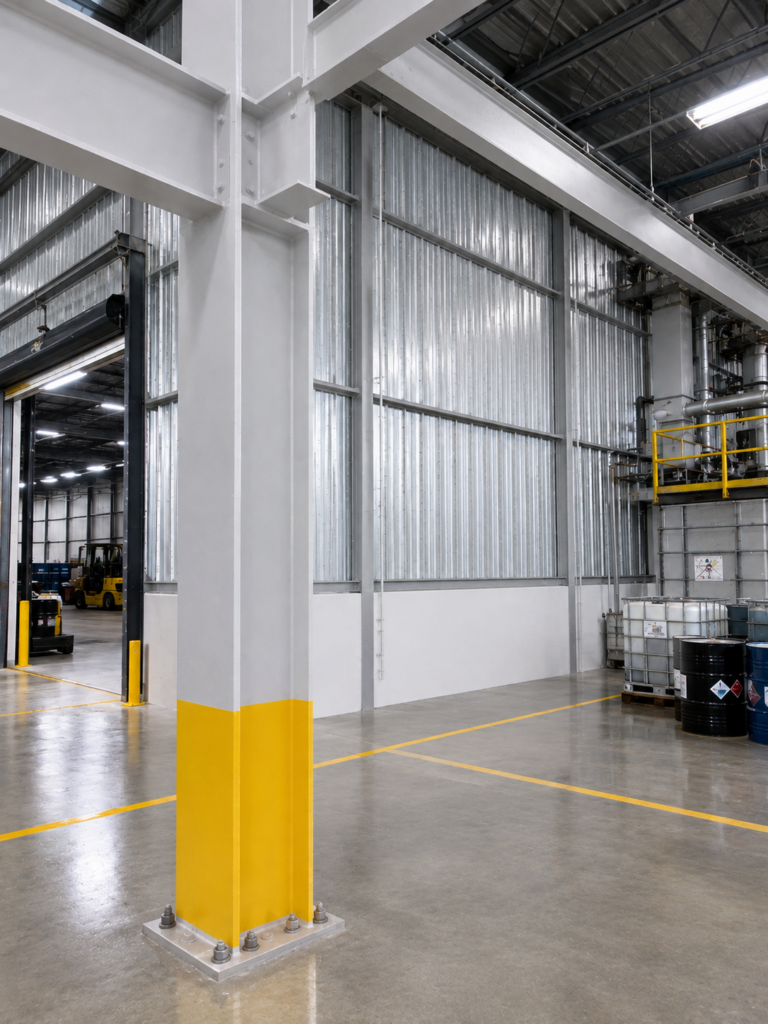
Not every building needs industrial painting. A retail storefront with drywall and trim is a commercial job. A warehouse with steel beams, concrete floors, or equipment exposed to chemicals and heavy moisture needs industrial coatings. The substrate decides the scope, not the building’s size.
- Substrate — drywall and wood trim mean commercial; steel, galvanized metal, and concrete mean industrial
- Exposure — moisture, chemical splash, heat, or heavy equipment traffic call for coatings built for that stress
- Code and safety — some manufacturing spaces need systems tied to fire ratings or slip resistance
- Downtime tolerance — industrial work gets scheduled around shift changes and production windows
- Surface condition — rust, corrosion, or chalking metal almost always calls for industrial coatings
Getting this wrong costs money later. Standard commercial paint on metal exposed to moisture can peel inside a year. Before anyone quotes your job, ask what the walls and floors are made of, then ask what that space goes through every day.
When You Don't Need a Full Industrial Repaint
A faded warehouse wall or scuffed loading dock does not automatically mean a full repaint. Often the real problem is one section damaged by a forklift, or a wall that never got the right coating in the first place.
If the coating is holding everywhere except a few spots — surface rust on one beam, peeling near a leaky gutter line, chipped trim around a loading door — spot repair usually does the job. A coating under five years old that is still bonded tight, with no bubbling or chalking, can generally wait. Cosmetic fading from sun exposure is an appearance problem, not a protection problem.
There is a simple test. Press a piece of tape on the wall and pull it off. If paint comes with it, that is coating failure, not fading. Then ask whether the damage is spreading or has looked the same for a year; stable damage in one area rarely calls for a full repaint.
One thing worth saying plainly: if the structure has moisture problems, rot, or active leaks, do not paint it yet. Fix that first. Paint over a wet substrate and you are buying the same problem again in a few months.


Inside an Industrial Painting Project: Prep to Final Inspection
The sequence is not complicated, but skipping steps is what makes coatings fail early. When a Gwinnett County warehouse coating peels within a year, it is almost always a prep problem rather than a paint problem.
- Walkthrough and surface assessment — rust, moisture, chalking, and structural issues get checked before anything else.
- Surface prep — degreasing, scraping, sanding, or pressure washing depending on the surface. Metal buildings around Lawrenceville often need rust treatment first.
- Repairs — substrate and drywall damage gets fixed now rather than painted over.
- Masking and protection — equipment, fixtures, and flooring get covered against overspray.
- Priming — bare metal and repaired spots get a primer matched to the surface.
- Coating — Sherwin Williams, PPG, or Benjamin Moore industrial products, sprayed, rolled, or brushed to suit the surface.
- Final inspection — we walk the site with you before calling the work complete.
Work gets scheduled around shift changes and production windows so painting does not shut you down. Every job carries a written one-year warranty.
How Industrial Coating Pricing Works
Square footage matters, but surface condition usually affects the price more than size does. A rusted steel beam takes longer to prep than a smooth concrete wall three times its size. On plenty of jobs the coating is the easy part, and the grinding and degreasing take most of the day.
- Level of prep needed, from light cleaning to full abrasive blasting or grinding
- Coating type and the number of coats the substrate requires
- Access difficulty, including lifts, scaffolding, or confined spaces
- Ventilation and containment needs when work happens near active operations
- How much rust, chemical residue, or failed coating has to come off first
Ask any contractor three questions before signing: what prep method will you use, how many coats are included, and what happens if hidden rust turns up after work begins. Vague answers tell you a lot. Compare what is included rather than the bottom line — a quote that skips prep and sprays over what is there costs less today and more in two years.
Frequently Asked Questions
Your building needs industrial painting if it has exposed steel, concrete floors, or surfaces facing chemicals and moisture. A retail space with drywall and trim only needs commercial painting. Standard paint on exposed metal can peel within a year if it is the wrong product for the job.
We check for rust, chalking, moisture, and structural issues before touching a brush, looking at seams, bolt heads, and low spots where water pools first. That walkthrough tells us whether you need a full repaint or spot repair. Active leaks or rot get flagged before any painting begins.
Yes. Humidity swings speed up failure on steel and concrete, and south-facing warehouse walls chalk first. Moisture also gets trapped under coatings during humid stretches, causing blisters later. Walking the exterior once a season helps you catch it while a maintenance coat still works.
Often, yes. If your coating is under five years old, still bonded tight, and not chalking or bubbling, isolated damage like one rusted beam or a forklift-damaged wall can be handled on its own. A simple tape test tells us whether a section has failed or is only faded.
We plan around your shift changes and production windows so painting does not shut you down. Equipment, fixtures, and flooring get masked off before we start, and once prep, priming, and coating are done we walk the site with you for a final inspection.